
Electromagnetic Maglock Locks in Puerto Rico: Benefits, Applications, Installation, and ADA Compliance
Updated: 3 days ago
Locksmith One | Electronic Security and Access Control | November 2026
Electromagnetic locks, commonly known as maglocks, Magnalocks, or magnetic locks, are among the technologies used in modern access control systems. Their applications include condominiums, offices, commercial buildings, institutional facilities, and common areas where managing access is essential.
However, installing a maglock involves more than simply attaching an electromagnet to a door. It also requires evaluating the type of structure, electrical power supply, release mechanisms, emergency evacuation routes, and accessibility requirements established by the Americans with Disabilities Act (ADA).
In Puerto Rico, these installations must also be evaluated according to applicable building and fire protection codes.
In this article, we explain how maglocks work, their advantages and limitations, the differences between their applications, and the considerations involved in properly installing them on wooden, glass, aluminum, and security gates.
What Is a Magnetic Lock or Maglock, and How Does It Work?
A maglock is an electromagnetic device that keeps a door closed through the attraction force generated by an electromagnet.
It generally consists of two main components:
Electromagnet: Installed on the door frame or an appropriate structural support.
Armature plate: A metal plate installed on the door leaf that makes contact with the electromagnet.
When the device receives electricity, it generates a magnetic field that attracts the plate and keeps the door closed.
When the electrical supply is interrupted, the holding force disappears, and the system releases the door.
This operation is known as fail-safe, although releasing the magnetic lock does not necessarily mean that other locking mechanisms on the door have also been unlocked.
Technical Specifications of Electromagnetic Locks
Specifications vary depending on the manufacturer, model, and application.
Feature | Description |
Holding force | Common models rated at 600, 1,200, and up to 3,000 pounds |
Power supply | Frequently 12 VDC or 24 VDC |
Electrical consumption | Varies according to the model and voltage |
Operation | Fail-safe |
Construction | Electromagnet and armature plate |
Monitoring | Some models include magnetic bond sensors |
Accessories | L, Z, and U mounting brackets, depending on installation |
Integration | RFID systems, keypads, intercoms, and electronic controllers |
The manufacturer's rated holding force does not, by itself, represent the strength of the entire assembly. The frame, anchors, alignment, and door structure also affect its performance.
Benefits of Using Maglocks in Access Control Systems
1. Installation Versatility
Magnetic locks can be used on different types of doors and structures, provided that the appropriate brackets and accessories are used.
Applications include tempered glass, aluminum, wooden, and metal doors, as well as certain pedestrian gates.
2. Holding Force
Models are available with different holding capacities for residential, commercial, and institutional applications.
Selection should consider the type of door, operating conditions, and system requirements.
3. Reduced Wear on Moving Components
The electromagnetic holding mechanism does not use a conventional moving latch. This can reduce certain mechanical problems, although the equipment still requires inspection and maintenance.
4. Integration With Access Technologies
A maglock can be incorporated into systems that authorize entry through cards, codes, remote controls, intercoms, or mobile applications.
5. Centralized Management
In buildings with multiple doors, the system can facilitate the management of credentials, schedules, and access events.
6. Integration With Security Systems
Depending on the design and applicable requirements, it can be integrated with fire alarm systems, exit devices, and monitoring systems.
Important: The fact that a magnetic lock is fail-safe does not, by itself, guarantee that the entire installation complies with emergency evacuation and fire safety requirements.
Scenario 1. Maglocks on Gates Providing Access to
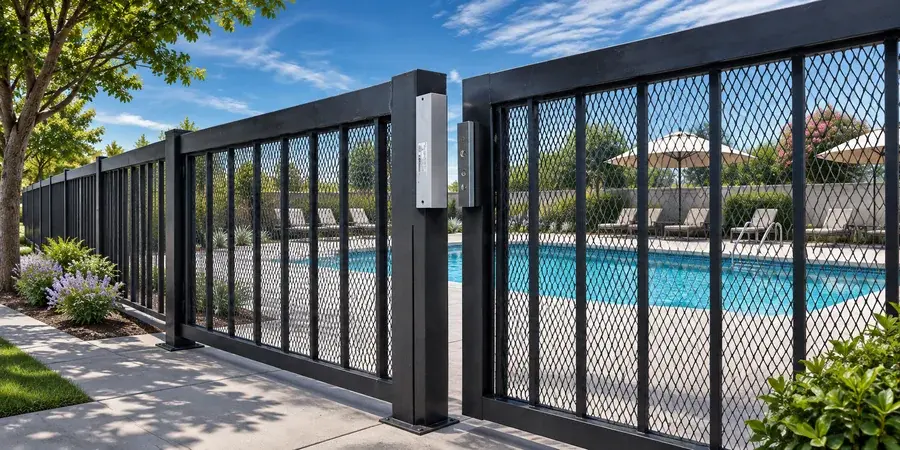
Swimming pools in condominiums, apartment complexes, hotels, and recreational facilities require security measures to limit unauthorized access.
A maglock can be part of an access control system that manages entry through cards, codes, or electronic credentials.
For example, a condominium may use a system that authorizes access to the swimming pool only during hours established by management.
Important Considerations for Swimming Pools
Electronic access control does not replace the physical protection mechanisms required to prevent unsupervised access by children.
Pedestrian gates forming part of swimming pool barriers must be evaluated to ensure compliance with applicable requirements for self-closing, self-latching mechanisms, and opening direction. The United States Consumer Product Safety Commission recommends these measures in its swimming pool safety guidelines.
Additionally, the ADA includes specific provisions concerning certain locking mechanisms on gates protecting swimming pools, spas, and hot tubs. These exceptions must be carefully evaluated before establishing the device's mounting height.
A magnetic lock that releases the gate during a power failure does not automatically replace the closing and latching mechanism required for a swimming pool barrier.
Recommendation: Before installing a maglock at a swimming pool entrance, evaluate child protection, accessibility, exit safety, and continuity of access control together.
Scenario 2. Maglocks on Glass Doors in Offices and Reception Areas

Glass doors are common in corporate offices, professional buildings, clinics, and commercial establishments.
In this type of installation, maglocks provide a solution that can be integrated into the architectural design without using a conventional mechanical lock as the electronic holding mechanism.
Example of Operation
An office has a reception area where each visitor's authorization is verified.
The receptionist can electronically release the door using a control connected to the access control system.
Authorized employees can use RFID cards or other credentials to enter.
Installation Requirements
The installation must consider the type and thickness of the glass, compatible mounting brackets, installation stability, and door movement.
Applicable accessibility and exit requirements must also be evaluated, including the conditions under which the door must unlock.
An access control system must not prevent occupants from evacuating when free and immediate exit is required.
Scenario 3. Electromagnetic Locks on Aluminum-Framed Doors

Aluminum-framed doors are widely used in commercial establishments, offices, condominiums, and institutional buildings throughout Puerto Rico.
Their structure allows different configurations for installing electromagnetic devices, although the available space and strength of the frame must be evaluated before selecting the equipment.
Aspects That Must Be Considered
Type of aluminum profile: Some frames provide sufficient space to install the electromagnet directly, while others require special brackets.
Door configuration: The mounting arrangement changes depending on whether the door swings inward or outward.
Alignment: The electromagnet and armature plate must maintain proper contact.
Wiring protection: Electrical connections must be installed in a way that reduces the risk of damage or tampering.
Release system: It must be selected according to the evacuation conditions required for the installation.
Poor installation can compromise holding force and cause recurring failures.
Scenario 4. Maglock on a Wooden Door With an Interior REX Exit Button

Wooden doors are common in administrative offices, restricted areas, institutional facilities, and rooms intended for equipment or document storage.
In these situations, a maglock can be installed at the top of the door and, when appropriate for the approved exit design, an interior release button known as REX (Request to Exit).
The purpose of the button is to allow a person to activate the system's release from inside.
However, the button's location and operation must comply with applicable accessibility and emergency evacuation requirements.
At What Height Should an Exit Button Be Installed Under ADA Requirements?
The ADA establishes different requirements for operable components, door hardware, and approach clearances.
Element | Reference height above finished floor |
Operable components with unobstructed reach | 15"–48" (38–122 cm) |
Operable hardware on accessible doors | 34"–48" (86–122 cm) |
Manual exit button for sensor-release doors under IBC 2018 §1010.1.9.9 | 40"–48" (102–122 cm) |
Proposed design height for the REX button in this example | 42"–45" (107–114 cm) |
The ADA does not specifically require all REX buttons to be installed at 42"–45". That range is a design choice within the 40"–48" range established by IBC 2018 for the indicated configuration, provided all other applicable requirements are met.
Other Accessibility Requirements
Section 309.4 of the ADA Standards establishes that accessible operable components must be usable with one hand, without requiring tight grasping, pinching, or twisting of the wrist.
The maximum activation force is generally five pounds (22.2 N).
An appropriate approach space must also be provided for individuals who use wheelchairs or other mobility devices.
Simply installing a button at a particular height is not enough: accessibility depends on the entire installation.
Operation During an Emergency
For exit doors where an electrical lock is released by a sensor, IBC 2018 §1010.1.9.9 establishes conditions that include:
An accessible manual release device identified as PUSH TO EXIT, located within five feet of the door.
Direct interruption of the electrical power to the lock, independent of other electronic components.
The lock must remain released for at least 30 seconds after the device is activated.
Release upon loss of electrical power and upon certain fire system activations, as specified by the section.
These requirements apply specifically to that regulatory configuration. Other types of electrically locked doors or release systems may be subject to different provisions.
ADA and Safety Codes Applicable to Maglocks in Puerto Rico
The Americans with Disabilities Act establishes accessibility requirements for certain public and commercial facilities. However, ADA compliance does not replace life safety, fire protection, or emergency evacuation requirements.
In Puerto Rico, the 2018 Construction Regulations adopted various international codes, with local amendments, including the International Building Code (IBC), International Fire Code (IFC), and International Swimming Pool and Spa Code (ISPSC).
Before any installation, the applicable code edition and amendments in effect for the project must be verified.
Important Aspects of an Accessible Installation
Control height: Buttons and operating devices must be positioned within the ranges permitted by the applicable standard.
Physical access: Adequate space must be available for individuals with reduced mobility to approach and operate the device.
Ease of operation: Users should not be required to perform complex hand or wrist movements.
Accessible doors: Clear opening width, maneuvering clearances, opening force, and operating hardware must also be evaluated.
Emergency evacuation: The access control system must allow safe exit in accordance with applicable codes.
The Difference Between ADA Compliance and Fire Code Compliance
A door may have a button installed at an accessible height and still fail to comply with emergency evacuation requirements.
For example, if a REX device depends exclusively on an electronic controller that may fail and does not incorporate the independent release required for its configuration, the installation could be inadequate.
For this reason, the evaluation must address accessibility, access control, and life safety together.
Fail-Safe vs. Fail-Secure: What Is the Difference?
These terms describe the behavior of an electrical locking mechanism when power is lost.
Feature | Fail-safe | Fail-secure |
Upon power loss | Releases the electrical lock | Maintains the electrical lock |
Example | Conventional maglock | Certain electric strikes |
Application | Access control where release is required upon power loss | Entrances requiring the controlled side to remain locked |
Exit safety | The entire system must be evaluated | Required emergency evacuation must also be ensured |
A fail-secure device does not necessarily mean that a person becomes trapped during a power outage.
Many systems keep entry locked from the outside while allowing occupants to exit using mechanical hardware.
Selection must respond to security needs and the building's emergency evacuation conditions.
Integration of Maglocks With Modern Access Control Systems
A magnetic lock can be combined with different technologies.
RFID Cards and Key Tags
These allow entry to be authorized through proximity credentials, which can be activated or deactivated through the system.
Numeric Keypads
These facilitate access through individual or shared codes, depending on the system's programming.
Remote Controls
Remote controls can be used for certain pedestrian entrances, administrative areas, and compatible gates.
Mobile Applications
Some controllers allow digital credentials to be managed and access to be authorized through smartphones.
Intercom Systems
Intercoms allow reception or security personnel to verify an entry request and release the lock.
Video Surveillance Systems
When compatible integration is available, access events can be associated with security camera footage.
The selection of these technologies must consider security policies, data protection, operational continuity, and the type of installation.
Limitations and Vulnerabilities of Electromagnetic Locks
Although they offer important advantages, maglocks also have limitations.
Dependence on Electricity
A conventional maglock requires electrical power to maintain its holding force.
When power is lost, the magnetic locking mechanism releases.
Alignment Problems
If the armature plate does not make proper contact with the electromagnet, the holding force may be reduced.
Wiring Damage or Tampering
Exposed or inadequately protected electrical connections may affect the system's operation.
Structurally Deficient Installations
A maglock's rated capacity does not correct problems involving anchors, deteriorated frames, or improperly adjusted doors.
Incorrect Exit System Configuration
Improper wiring or configuration may prevent release devices from operating as required by the approved design.
Best Practices for Installation and Maintenance
To achieve reliable operation, the following practices are recommended:
Evaluate the characteristics of the door, frame, and structure before selecting the equipment.
Use magnetic locks and accessories appropriate for the application.
Install compatible power supplies and protect the wiring.
Evaluate backup battery requirements without compromising emergency release.
Verify the corresponding REX devices, sensors, hardware, and alarm systems.
Periodically inspect alignment, connections, and anchors.
Document operating tests and emergency evacuation conditions.
Backup batteries deserve special attention. Although they can keep the access control system operational during a power interruption, they must not prevent the emergency release required by applicable codes.
Installing an additional mechanical lock is not always necessary.
That decision depends on the door's function and applicable requirements. An incorrectly selected additional locking mechanism could create an evacuation hazard.
Common Maglock Applications in Puerto Rico
Condominiums and Residential Complexes
Electromagnetic systems can be used at lobby entrances, common areas, activity rooms, and certain pedestrian gates.
Integration with intercom systems allows management or authorized personnel to control visitor entry.
Offices and Commercial Buildings
These systems allow access to reception areas, administrative departments, and restricted areas to be managed.
Medical Facilities
Maglocks can be used in areas requiring controlled staff movement, provided that the design complies with requirements specific to the occupancy.
Recreational Areas
Maglocks can form part of electronic access control systems for gyms and swimming pools without replacing mandatory physical barriers and protective measures.
Server Rooms and Technical Areas
Electronic access control facilitates the recording and management of authorized entry.
The appropriate locking mechanism must be selected while considering equipment protection and safe exit.
Frequently Asked Questions About Maglocks and ADA Accessibility
Is a Maglock the Same as a Conventional Lock?
No. A maglock uses electromagnetic force to hold a door closed, while a conventional mechanical lock uses physical locking components.
Can a Maglock Be Installed on a Glass Door?
Yes, provided that a configuration compatible with the glass, its mounting brackets, and the door's characteristics is used.
At What Height Should a REX Button Be Installed?
It depends on the configuration and applicable codes.
For manual release devices in sensor-release systems covered by IBC 2018 §1010.1.9.9, the height range is 40 to 48 inches above the finished floor.
A design height of 42 to 45 inches can fall within that range.
Does Every REX Button Comply With ADA?
No. In addition to mounting height, activation force, ease of operation, and clear approach space must be evaluated.
Do Maglocks Release the Door During a Power Outage?
Conventional maglocks are fail-safe and release their holding force when electrical power is lost.
However, other locking devices that may be present must also be evaluated.
Can Maglocks Be Installed at Swimming Pools?
Yes, in certain configurations.
However, the system must comply with applicable child protection, gate-closing, accessibility, and exit requirements.
Is a Backup Battery Mandatory?
There is no universal rule requiring a backup battery for every maglock installation.
Its necessity depends on the project, system functions, and applicable codes.
Can an Intercom Release a Maglock?
Yes. If the components are compatible, the intercom can send a signal to the controller to authorize entry.
Is It Mandatory to Connect a Maglock to the Fire Alarm System?
It depends on the occupancy, the locking system configuration, and applicable requirements.
Certain installations require automatic release when fire protection systems are activated.
Does a Maglock Replace a Panic Bar?
Not necessarily.
When a door requires panic hardware or fire exit hardware, the electromagnetic system must be designed to comply with those requirements.
Conclusion: Access Control, Accessibility, and Security Must Work Together
Electromagnetic locks provide a versatile solution for managing access in condominiums, offices, commercial establishments, and institutional buildings throughout Puerto Rico.
Their effectiveness depends not only on the magnetic lock's holding force but also on equipment selection, mounting quality, release system operation, and compliance with accessibility and life safety requirements.
A professional installation must consider both property protection and the ability of individuals to use doors and evacuate safely.
Locksmith One: Access Control Solutions in Puerto Rico
At Locksmith One, we offer locksmith services and security solutions for residential and commercial properties, including guidance on electromagnetic locks and electronic access control systems.
Each installation must be evaluated according to the door's characteristics, the client's needs, and the applicable safety requirements.
YOUR SECURITY IN GOOD HANDS.
Address: 523 F. D. Roosevelt Avenue, San Juan, PR 00918Phone: (787) 664-5557
Website: www.locksmith24hours.com
Do you need to evaluate an access control system for your property? Call now at (787) 664-5557.
Editorial note: Image filenames do not constitute certification of ADA compliance. If an installation has not been inspected, it is preferable to describe the button as being at an accessible design height rather than claiming the installation is ADA-approved.


Comments